
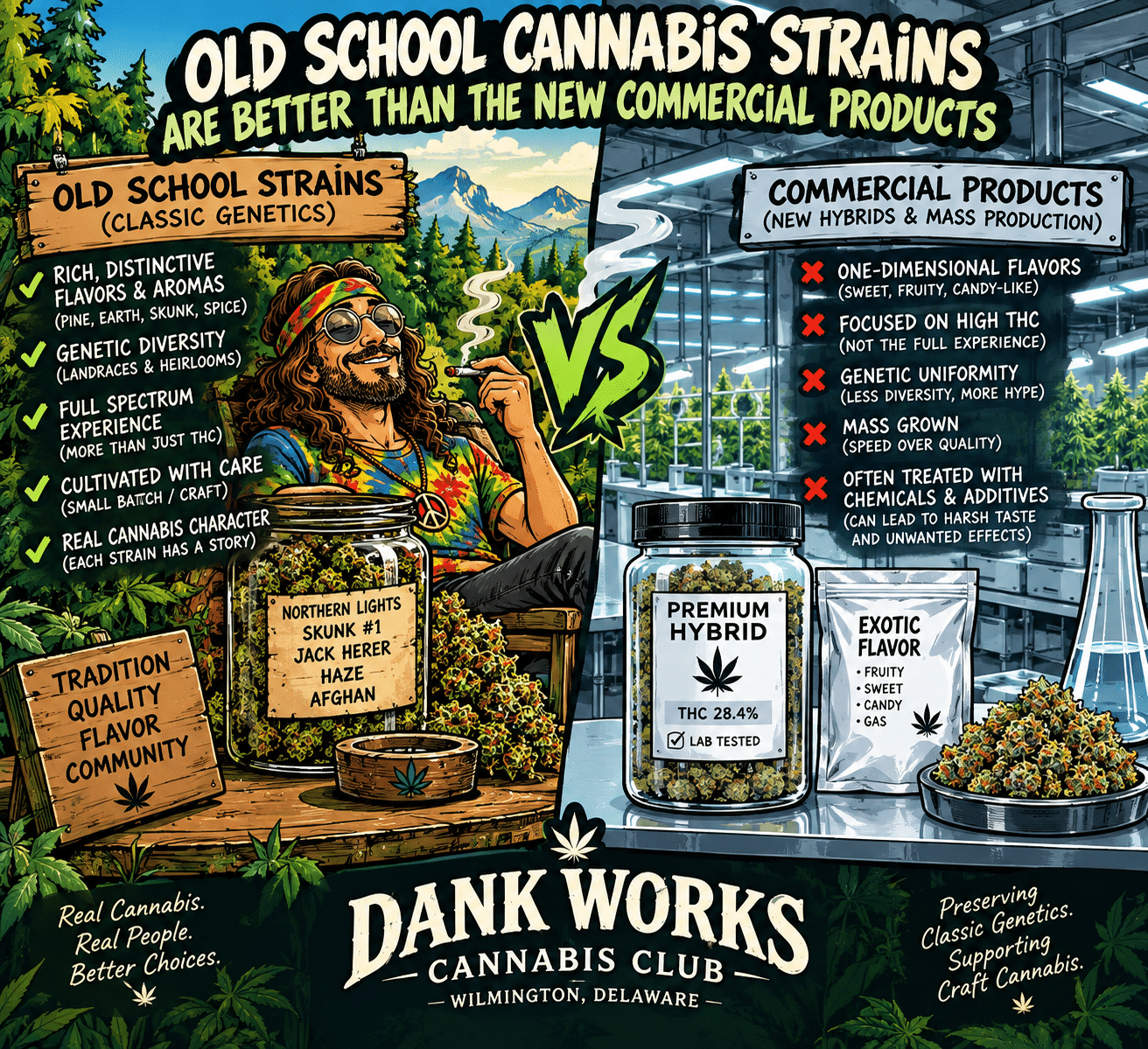
Remember When Weed Actually Tasted Like Weed?
If you’ve been smoking cannabis for a while, you probably know what we’re talking about.
There was a time when different strains had unmistakable personalities. Some smelled like fresh pine and forest soil. Others had that pungent, unmistakable skunk aroma, spicy herbal notes, or the earthy sweetness that made certain old-school varieties legendary. You could open a bag and know you were dealing with something distinctive before you even saw the flower.
Today, cannabis can look more impressive than ever. The buds are often enormous, the colors can be spectacular, and THC percentages seem to climb higher with every new release.
But here’s a question more cannabis enthusiasts are asking: If modern weed is supposedly better, why do so many people miss the taste, aroma, and character of old-school cannabis?
At Dank Works Cannabis Club in Wilmington, Delaware, we believe cannabis deserves to be about more than inflated THC numbers, flashy packaging, and whatever trendy strain name is dominating the market this week.
We’re passionate about preserving classic cannabis genetics, producing distinctive artisanal cannabis, and keeping the qualities that made old-school weed special alive for the next generation.
Because bigger buds don’t automatically mean better weed. And higher THC doesn’t automatically mean a better experience.
1. Old-School Weed Had Character That You Could Recognize
One of the biggest differences longtime cannabis enthusiasts often notice is the distinctive character of older strains.
Classic varieties such as Northern Lights, Skunk #1, traditional Haze lines, and established Afghan-derived genetics earned their reputations through recognizable characteristics and their influence on cannabis breeding.
These varieties helped establish the flavor and aroma diversity that made exploring cannabis strains so interesting.
Depending on the specific genetics, growers, and phenotype, classic cannabis could deliver:
Pungent, skunky aromas that were unmistakable.
Earthy and woody flavors reminiscent of soil, pine, and forest vegetation.
Spicy, herbal notes that gave traditional Haze varieties their distinctive appeal.
Complex aromatic profiles that went beyond simply smelling sweet or fruity.
Individual strain identities that made one cultivar noticeably different from another.
Modern cannabis can absolutely deliver these characteristics, too. The problem isn’t that every new strain is inferior. It’s that some enthusiasts feel the market has become overly focused on a narrower range of commercially popular traits.
When breeding decisions prioritize fashionable aromas, extreme THC levels, appearance, and production efficiency, other characteristics can receive less attention.
At Dank Works, we believe cannabis genetics deserve to be explored for their full character—not just their ability to produce impressive numbers on a laboratory report.
2. Why Are Older Weed Strains Better Than Some Modern Strains?
Let’s be clear: older cannabis isn’t automatically superior to modern cannabis. Breeding has produced valuable improvements in plant health, consistency, cultivation efficiency, and the range of available cannabinoid and terpene profiles.
However, older genetics can offer something that deserves greater recognition: diversity, history, and distinctive characteristics that shouldn’t disappear simply because market trends change.
Classic genetics deserve to survive
Many modern cannabis varieties descend from established cultivars and genetic lines that helped shape cannabis breeding over decades.
Northern Lights, Skunk #1, Haze varieties, and Afghan-derived genetics have all played important roles in that history.
As breeders continually create new crosses, certain older lines can become harder to find in their original or well-documented forms. Preserving them helps protect genetic resources for future growers and breeders.
More THC isn’t the only goal
The modern obsession with THC percentage can leave consumers with an incomplete picture of cannabis quality.
Two cultivars with similar THC levels can smell, taste, and feel very different. Their cannabinoid compositions and aromatic compounds may differ considerably.
A strain with a distinctive aroma and a well-preserved terpene profile may be more appealing to someone who values flavor than a product selected primarily for maximum THC.
Genetic diversity creates more interesting cannabis
Cannabis has an enormous range of genetic characteristics. Preserving established cultivars and exploring less common lines gives growers more opportunities to cultivate distinctive plants instead of repeatedly chasing the same commercial trends.
For us, that’s one of the most exciting parts of craft cannabis: discovering and preserving characteristics that make each variety worth experiencing.
3. Why Does Commercial Weed Sometimes Taste Funny?
Have you ever opened a container of cannabis expecting a rich, pungent aroma, only to encounter something that smells strangely grassy, musty, harsh, or simply unlike what you expected?
Have you ever tried a product that looked fantastic but delivered a disappointing flavor?
There isn’t one universal explanation for these experiences. Cannabis quality is influenced by genetics, cultivation, harvesting, drying, curing, storage, and processing.
However, commercial production practices can affect the final product, particularly when speed, yield, or shelf life receive more attention than preserving the flower’s natural characteristics.
Improper drying and curing
Drying and curing are critical parts of cannabis production.
Drying cannabis too quickly, storing it under unsuitable conditions, or failing to manage moisture appropriately can compromise aroma and texture. Poor post-harvest handling can leave flower tasting harsh, grassy, stale, or otherwise disappointing.
A carefully managed drying and curing process helps preserve desirable sensory characteristics. It cannot fix every problem, but it can make a meaningful difference.
Excessive heat, light, and poor storage
Cannabis contains volatile aromatic compounds that can be lost or altered during handling and storage.
Exposure to excessive heat, light, oxygen, and unsuitable humidity can reduce freshness and change a product’s aroma and overall quality.
This is one reason a freshly harvested, carefully handled flower may smell very different from an older product that has spent too much time in poor storage conditions.
Genetics and breeding choices
Not every cannabis strain has the same aromatic profile. Some varieties naturally produce more pungent, earthy, skunky, or herbal aromas, while others lean toward sweet, fruity, or dessert-like characteristics.
If a producer repeatedly selects for one commercially popular aroma profile, consumers may encounter less of the diversity they associate with traditional cannabis.
Cultivation inputs and residue concerns
Plant nutrition is essential to healthy cannabis cultivation. Fertilizers and other cultivation inputs are not inherently harmful when properly selected and used.
However, inappropriate application of fertilizers, pesticides, plant-growth products, or other inputs can create quality or safety concerns. Certain residues may persist if products are misused, and contaminated cannabis can pose health risks.
That is why responsible cultivation, appropriate input management, and reliable laboratory testing matter.
A strange taste or smell alone does not prove that cannabis contains harmful chemicals. Genetics, moisture, storage, and post-harvest handling can also affect sensory quality. Laboratory testing is necessary to identify many contaminants.
At Dank Works, we believe consumers deserve cannabis produced with care, attention to detail, and a serious commitment to product quality.
4. Is Commercial Cannabis Loaded With Chemicals?
The word chemical gets used a lot in cannabis discussions, but it’s important to distinguish between the substances used to cultivate a plant and harmful contamination.
All plants require nutrients. Cannabis growers may use organic fertilizers, mineral nutrients, compost, biological pest-management methods, or other agricultural inputs. The use of a fertilizer does not automatically mean the finished cannabis is contaminated or unsafe.
The real questions are:
What inputs were used during cultivation?
Were they appropriate for the crop and applied according to their directions?
Were pest-management practices responsible?
Was the flower dried, cured, and stored correctly?
Was the finished product tested for relevant contaminants?
Can the producer explain its practices and quality-control procedures?
Commercial cannabis is not automatically inferior, and artisanal cannabis is not automatically clean. Both require responsible production.
However, large-scale operations can face pressures to maximize yield, standardize production, and move products through supply chains efficiently. Those pressures make transparent quality-control practices particularly important.
At Dank Works Cannabis Club, our philosophy emphasizes thoughtful cultivation, careful handling, and respect for the plant. We want our cannabis to be appreciated for its distinctive qualities—not simply marketed with an impressive THC number.
We also believe consumers should be able to ask meaningful questions about how their cannabis is grown and handled.
Because when it comes to quality, what happens to the plant from seed to finished flower matters.
5. What Makes Craft Cannabis Different?
Craft cannabis is about an approach to production that prioritizes attention to detail, thoughtful selection, and product character.
Rather than measuring success only by yield, appearance, or potency, craft-focused growers can place greater emphasis on the characteristics that distinguish one cultivar from another.
At Dank Works Cannabis Club, our approach is built around several principles.
Respect for cannabis genetics
We believe established cannabis varieties deserve continued attention. Classic genetics can offer distinctive characteristics and valuable breeding history, and preserving them helps maintain the diversity of the plant.
Careful cultivation
Healthy plants require appropriate nutrition, environmental management, and responsible pest control. Cultivation decisions influence the quality and consistency of the final product.
Attention to aroma and flavor
Cannabis should be appreciated as a complex agricultural product. Aroma and flavor are meaningful parts of its identity, and they deserve attention alongside potency and appearance.
Responsible post-harvest handling
Harvest timing, drying, curing, and storage all influence the finished flower. Careful handling helps preserve the qualities growers worked to develop.
Quality over hype
We believe a cannabis product should be valued for its actual characteristics, not just its packaging, marketing, or laboratory numbers.
These principles are central to our appreciation for artisanal cannabis and our commitment to keeping traditional cannabis qualities relevant.
6. Why Dank Works Cannabis Club Is Working to Preserve Older Weed Strains
At Dank Works Cannabis Club in Wilmington, Delaware, we believe the future of cannabis should not come at the expense of its past.
Classic cannabis genetics represent decades of cultivation, selection, and breeding. They helped establish the diversity of aromas, flavors, and plant characteristics that made cannabis such an interesting plant to explore.
As the market continues to evolve, we believe preserving those qualities matters.
Our interest in older strains is about more than nostalgia. It’s about keeping genetic diversity alive, exploring established cultivars, and appreciating the characteristics that can get overlooked when every new release is expected to be stronger, sweeter, more colorful, or more commercially appealing than the last.
We want cannabis enthusiasts to have opportunities to appreciate distinctive varieties rather than viewing every product through the same narrow lens.
Preserving the past while growing for the future
Preservation doesn’t mean rejecting every modern strain. It means recognizing that established genetics have value and deserve to remain part of cannabis culture.
Traditional cultivars and carefully selected modern hybrids can coexist. Each can contribute unique characteristics to the wider cannabis landscape.
By emphasizing artisanal cannabis and respect for the plant, Dank Works Cannabis Club supports a philosophy that values genetic heritage, responsible cultivation, and distinctive product qualities.
Bringing back an appreciation for the whole plant
Cannabis is more than THC.
Its identity includes genetics, cannabinoids, aromatic compounds, cultivation methods, and the care taken after harvest. Those elements work together to determine the characteristics of the finished flower.
We believe consumers should have the opportunity to appreciate that complexity.
For us, preserving older cannabis strains is part of preserving a richer cannabis culture—one that values the plant itself instead of chasing every new commercial trend.
7. Old-School Strains Worth Remembering
For anyone interested in classic cannabis genetics, several established cultivars and genetic families have made lasting contributions to cannabis history.
Northern Lights: A celebrated cultivar commonly associated with earthy, piney, and sometimes sweet aromatic characteristics.
Skunk #1: An influential classic known for the pungent skunky aroma associated with many traditional Skunk-derived lines.
Jack Herer: An established cultivar associated with herbal, spicy, piney, and sometimes citrus-forward aromatic characteristics.
Haze: A well-known family of genetics associated with complex herbal, spicy, woody, and citrus-like aromas.
Afghan-derived genetics: Important breeding resources that have contributed to many established cultivars, including lines selected for resin production and distinctive earthy or spicy characteristics.
Hash Plant genetics: Established breeding lines associated with resin-focused selection and often earthy, spicy aromatic profiles, although the characteristics depend on the specific genetic source.
These names represent a starting point, not a guarantee of identical genetics or quality. Cultivars can vary between breeders and versions, and strain names alone do not establish a product’s lineage.
For those who appreciate old-school cannabis, learning about the genetics behind a product can be just as interesting as discovering its aroma and flavor.
8. How to Find Better-Tasting, Responsibly Produced Cannabis
Whether you prefer old-school genetics or modern hybrids, there are practical ways to make more informed choices.
Look beyond THC percentage. Consider the product’s aroma, cannabinoid profile, freshness, and the characteristics you personally value.
Ask about cultivation practices. Responsible producers should be able to explain their approach to plant nutrition, pest management, and quality control.
Look for appropriate laboratory testing. Testing can help identify specified contaminants and verify product information. Review the actual testing documentation when available.
Pay attention to freshness and storage. Proper packaging and suitable storage help protect aroma and product quality.
Learn about the genetics. Established strain names can be useful starting points, but a transparent breeder or genetic history offers more information than a fashionable label alone.
Support producers who value quality and transparency. Seek out cultivators who can explain how they grow, handle, and test their products.
Ultimately, finding cannabis you enjoy is about understanding what matters to you and looking beyond marketing claims.
Why Dank Works Cannabis Club Believes Old-School Cannabis Still Matters
At Dank Works Cannabis Club, we’re proud to be part of a cannabis culture that values individuality, craftsmanship, and respect for the plant.
We recognize that modern cannabis has brought innovation and new possibilities. But we also believe the industry should not lose sight of the established genetics, distinctive aromas, and cultivation traditions that helped shape cannabis history.
We’re working to preserve the qualities that make classic cannabis worth remembering while emphasizing careful cultivation and attention to the finished product.
We believe cannabis should be appreciated for its character, not just its potency. We believe responsible production matters. And we believe consumers deserve meaningful information about the products they choose.
You don’t have to chase the newest strain to find something special. Sometimes, the real treasure is a classic worth preserving.
For cannabis enthusiasts in Wilmington, Delaware, and beyond, Dank Works Cannabis Club is committed to celebrating artisanal cannabis and keeping the appreciation for old-school genetics alive.
Because cannabis has a history worth protecting—and a future worth growing carefully.
Frequently Asked Questions
Why do older weed strains sometimes taste better than modern strains?
Some older cultivars have distinctive aromatic characteristics that enthusiasts particularly enjoy. However, flavor also depends on genetics, cultivation, drying, curing, and storage. Modern varieties can deliver exceptional flavor, too.
Why does some commercial weed taste harsh or strange?
Possible causes include poor drying or curing, unsuitable storage, natural genetic characteristics, and certain cultivation or processing problems. A strange taste does not by itself prove chemical contamination.
Are commercial cannabis products full of harmful chemicals?
Not necessarily. Commercial producers use a range of cultivation practices, and many products undergo regulatory testing. Improper use of agricultural inputs or contamination can create risks, so responsible cultivation and appropriate laboratory testing are important.
Are organic cannabis strains better?
The term organic does not automatically guarantee superior flavor, potency, or safety. Cultivation methods, genetic characteristics, post-harvest handling, and testing all contribute to the final product. Consumers should look for specific, verifiable information about how cannabis is produced.
Why is Dank Works Cannabis Club preserving older cannabis strains?
Dank Works values cannabis heritage, genetic diversity, distinctive strain characteristics, and artisanal cultivation. Preserving classic genetics helps keep established varieties and their unique characteristics part of cannabis culture.
Where is Dank Works Cannabis Club located?
Dank Works Cannabis Club is based in Wilmington, Delaware, and focuses on artisanal cannabis, community, and an appreciation for responsible cultivation and classic cannabis genetics.

Dank Works Cannabis Club is a Wilmington, Delaware–based Private Membership Association dedicated to promoting a healthier, more mindful cannabis lifestyle through premium, artisanal cannabis products. We foster a vibrant virtual community where members can connect, share experiences, and stay engaged. Beyond our online community, we regularly bring members together through community-driven social impact events that encourage connection, collaboration, and positive change.
Become a Member at: https://dank.works/member-registration